 Twitter
 Facebook
 Instagram
Walking through the storm: Buddhist monks take journey of peace
The route taken by the monks walking for peace took them through Liberty. (PJ Ward-Brown / Randolph Record)
Heads down, they walk, keeping a brisk pace. A winter storm bears down on them, and many have hoods drawn in the 28-degree weather.
Two dozen monks left the Theravada Buddhist temple in Fort Worth, Texas, in late October and started walking. Most of us have celebrated Halloween, Thanksgiving, Christmas and New Year’s. We’ve done holiday shopping and watched more than half of the NFL season and playoffs. They’ve been walking.
Some of them wear sandals, a nod to the weather. A few had been barefoot for much of the walk. Their journey will take them through eight states, 2,300 miles and 110 days, from Texas to D.C. They eat one meal a day, food donated to them.
It’s called the Walk for Peace, but their mission doesn’t sound politically charged.
“We walk not to protest, but to awaken the peace that already lives within each of us,” a written statement from the temple explains. “The Walk for Peace is a simple yet meaningful reminder that unity and kindness begin within each of us and can radiate outward to families, communities, and society as a whole.”
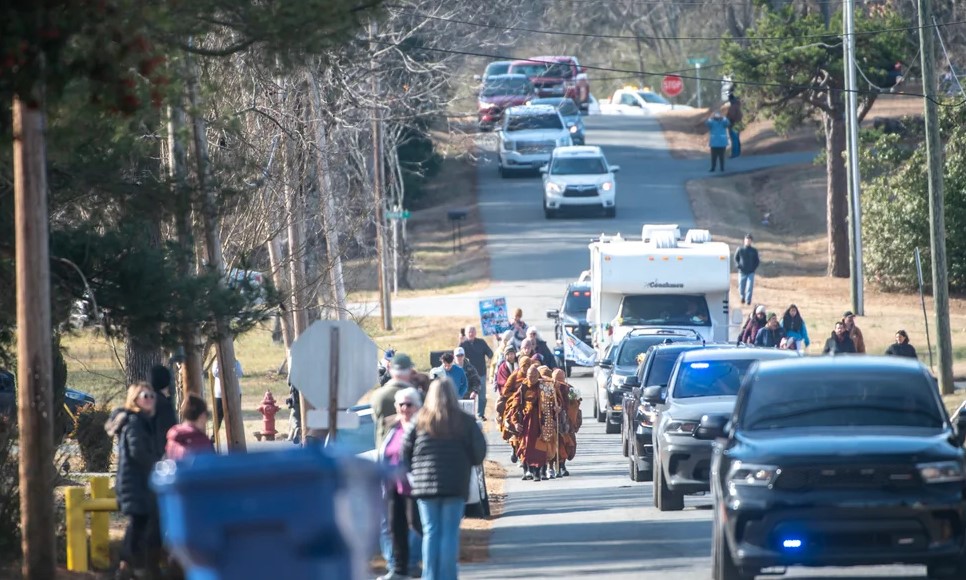
Last week, they were cutting through part of Randolph County. Later one morning, they’ve already traveled from Apex to Raleigh. They turn from Tryon Road onto Gorman Street, heading for Dorothea Dix Park, where they’ll eat today’s meal.
It’s the 91st day of their journey. They’ve lost a walker to a car accident in Houston and their dog to a leg injury, and there are still 20 days to go, likely the coldest and most choked with crowds that they’ve encountered yet. And every person they pass, every day, is seeing them for the first and only time.
More than 70 people emerge from the apartment complexes on both sides of the street, interrupting their storm prep to see them. Some drove from their apartment and parked in the entrance driveway — taking their car the tenth of a mile to see these men walking across the country.
Police officers stop traffic, turning cars back to take another route. Most drivers unroll their window to explain why they should be allowed to pass.
A van approaches slowly, with flashing lights, and cell phones are held aloft. “Here they come,” someone shouts, but it’s a false alarm. The van, advertising a local radio station, honks, and the passengers wave.
People go back to waiting. A news helicopter hovering nearby gives a good estimate of how close they are. Someone has a live stream up on their phone, reporting that they “just went under the bridge.” Someone else complains that the online map isn’t updating. One woman talks on her cell phone, explaining to a friend where the nearest shopping center is so she can park.
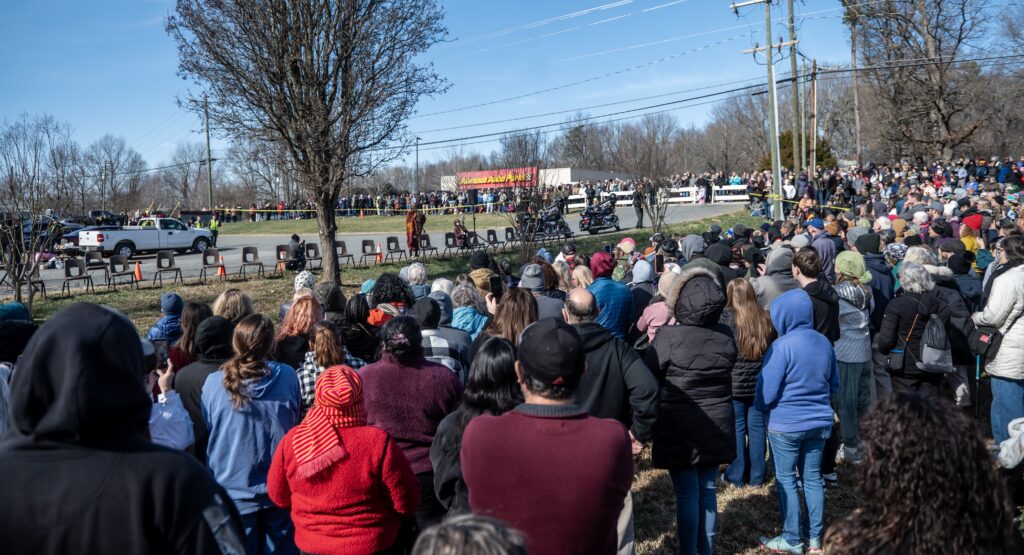
Finally, police motorcycles appear, lights flashing. Again, cell phones pop up, at the ready, to capture the striking image of the monks coming over the hill, in a group, walking for peace.
Except there is no striking image. It’s easy to see the police lights, the long line of traffic trailing behind and the people lining the road, crowding in front of them to get a good picture. The small cluster of monks, however, doesn’t stand out.
As they get closer, their earth-tone robes are visible. They walk, single file. The lead monk carries a staff. Another carries a flag. They walk quickly. People trying to catch up to the group after they pass have to jog to make up the ground. Their arms swing.
They say nothing. There’s no message, no sermon, no wisdom. They just walk. They are the embodiment of the cliché — a calm in the storm of chaos swirling around them, both on the street and in the nation they just crossed.
One shyly returns a wave to a child. Several people step forward with flowers. One monk near the back accepts a bouquet from a bystander. He walks on, and after going a short distance, he begins peeling flowers out of the bouquet, one at a time, and handing them to people watching them pass.
The crowd begins to break up. There is a storm to prepare for, photos and videos to post. People rave about how moving the experience was, including many who may have missed the point entirely.
They walk on.